



As it does every January, Nvidia unveiled this year’s new products at the annual Consumer Electronics Show (CES) in Las Vegas. While no new consumer video cards were announced, there was plenty of other interesting news from Nvidia, which I’ll introduce in this article.
DLSS 4.5 – Smarter MI solutions and staff generation
DLSS 4.5 is an evolution rather than a new version of MI-based image rendering technology. Nvidia has polished and improved almost all features. DLSS 4.5 offers significant improvements in image quality and performance with:
- a new second-generation MI model that will significantly improve Super Resolution image quality. In earlier versions of DLSS, flickering, blurred detail or doubling could be observed. DLSS 4.5 will use an improved neural model that better understands motion vectors, depth and previous frames. The result will be more stable edges, less flickering detail (tree canopies, fences, hair) and cleaner image quality in fast camera movements.
- Dynamic MultiFrame Generation. Frame generation will automatically adjust to the GPU load and display refresh rate.
- a new 6X mode that will be able to generate up to five additional frames per traditionally rendered frame, helping to achieve very high frame rates (e.g. 240Hz+) in 4K resolution with ray tracing on the latest RTX video cards. Gamers will get smoother motion, higher performance and a better image without using more powerful hardware.
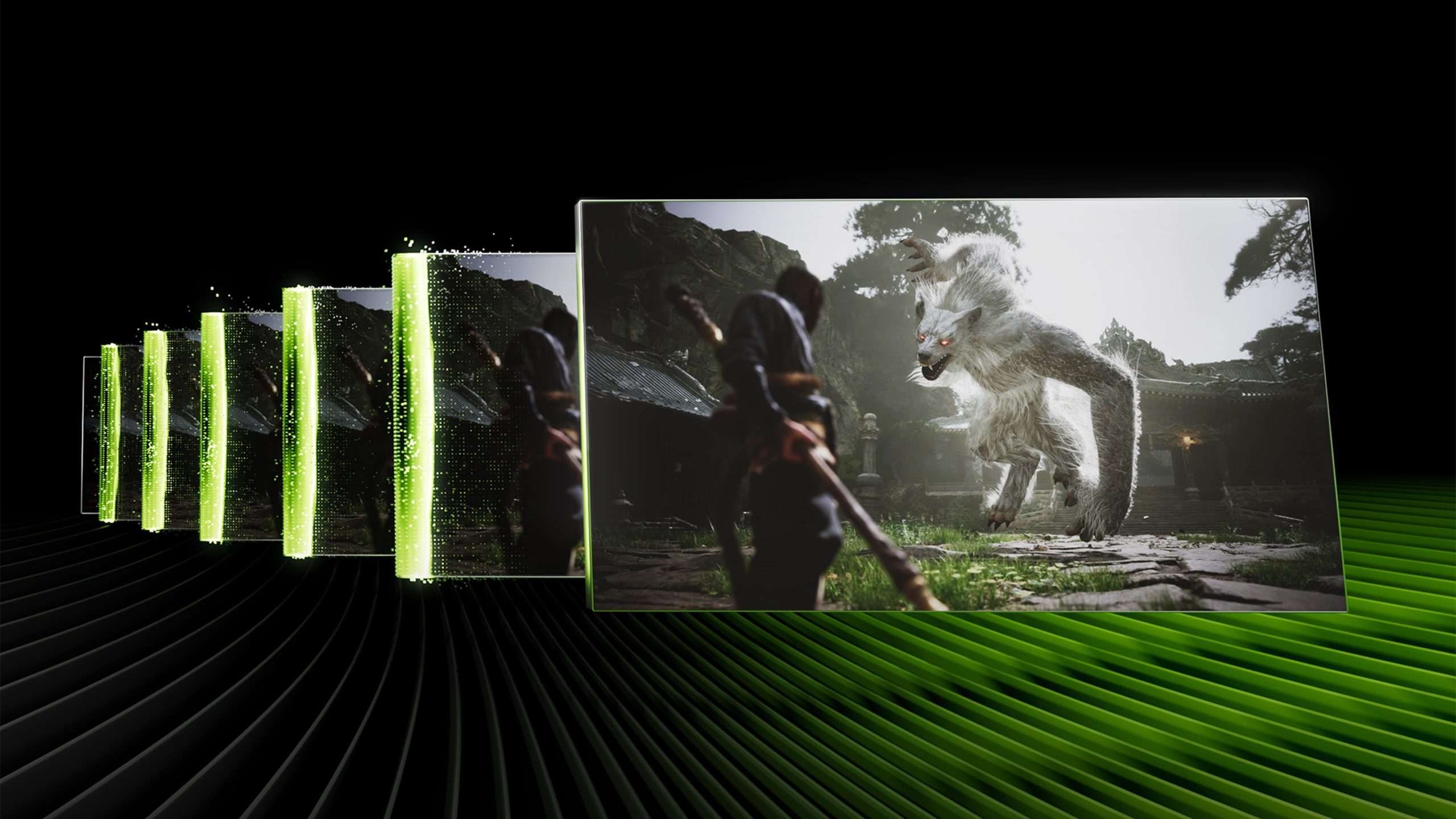
DLSS 4.5 will be able to generate up to five additional frames, improving FPS
Learn more about DLSS 4.5 in this video:
RTX AI – improvements for running local AI on our computers
RTX AI is not a single product, but a series of enhancements that will enable RTX video card-equipped PCs to better perform generative AI tasks – from video, image and text processing to locally-powered AI agents. Nvidia’s presentation showed performance improvements (up to 3x) that will allow users to create MI content on their PCs without using the cloud. This is sure to please content creators, MI enthusiasts and other users who want to quickly and privately work with MI without the cloud. Nvidia promises the following RTX AI enhancements:
- Up to 3x performance gain and 60% lower VRAM consumption with PyTorch-CUDA optimisation and support for new NVFP4/FP8 precision formats in ComfyUI.
- Built-in RTX Video Super Resolution ComfyUI for faster 4K video generation.
- NVIDIA NVFP8 optimisation for the new LTX-2 audio-video generation model.
- A new video generation system for creating 4K MI videos from 3D scenes in Blender, giving you more control over the final result.
- up to 35% faster inference performance for SLM models Ollama and llama.cpp.
- RTX acceleration for Nexa AI’s new Hyperlink video search feature.
G-SYNC Pulsar – the next generation of gaming display technology
G-SYNC Pulsar will be a major technological leap beyond the standard variable refresh rate (VRR). G-SYNC Pulsar is a completely new technology for gaming monitors that combines:
- Variable Refresh Rate (VRR) and backlight strobing for ultra-smooth and crystal-clear motion, achieving effective motion clarity of over 1000 Hz.
- Flicker-free operation while maintaining excellent image sharpness.
- Ambient Adaptive Technology, which automatically adjusts brightness and colour according to the room lighting.
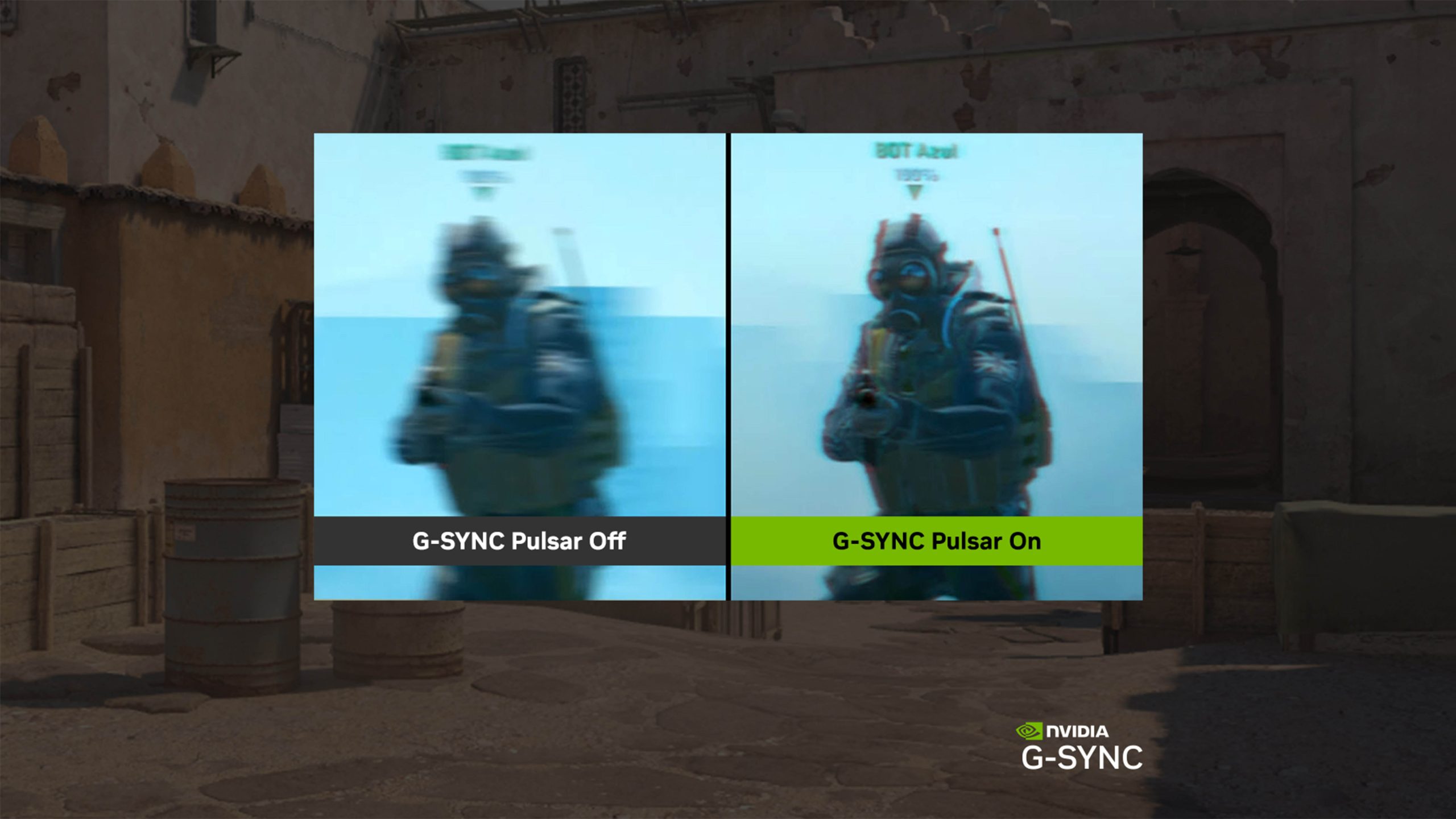
G-SYNC technology will reduce image blur in fast motion
For us as gamers and media consumers, this will mean smoother movement, reduced image jitter and an image that automatically adapts to its surroundings. We’ll be able to enjoy it when playing FPS games or watching movies late at night. Find out more about G-SYNC Pulsar technology in this video:
RTX Remix Logic – dynamic graphics for classic games
RTX Remix was originally created as a platform for remastering classic PC games with modern ray-traced visuals. The new RTX Remix Logic update will give modders the ability to trigger dynamic graphical effects in response to in-game events. The technology will allow in-game events to dynamically trigger visual changes such as weather, lighting and environmental effects – without access to the game’s source code. This will open up creative possibilities for the modding community – imagine classic RPGs that react visually to what we do, breathing new life into decades-old legends. Learn more about RTX Remix Logic in this Nvidia video:
Nvidia ACE – MI mentors and smarter gaming heroes
Nvidia ACE(AI Character Engine) uses machine learning to make the game’s characters behave more intelligently. At CES, Nvidia demonstrated an experimental AI advisor in Total War: Pharaoh that offers context-sensitive guidance. And in PUBG: Battlegrounds, the player’s MI teammate (Ally) evolves over time thanks to long-term memory capabilities. For us as players, this signals a shift from pre-programmed NPCs to adaptive, more lifelike characters that will greatly enhance the gaming experience.
Read more about these technologies on the Nvidia blog.
We also offer to buy PC kits and laptops, as well as RTX GeForce video cards in toppc.lt online shop.